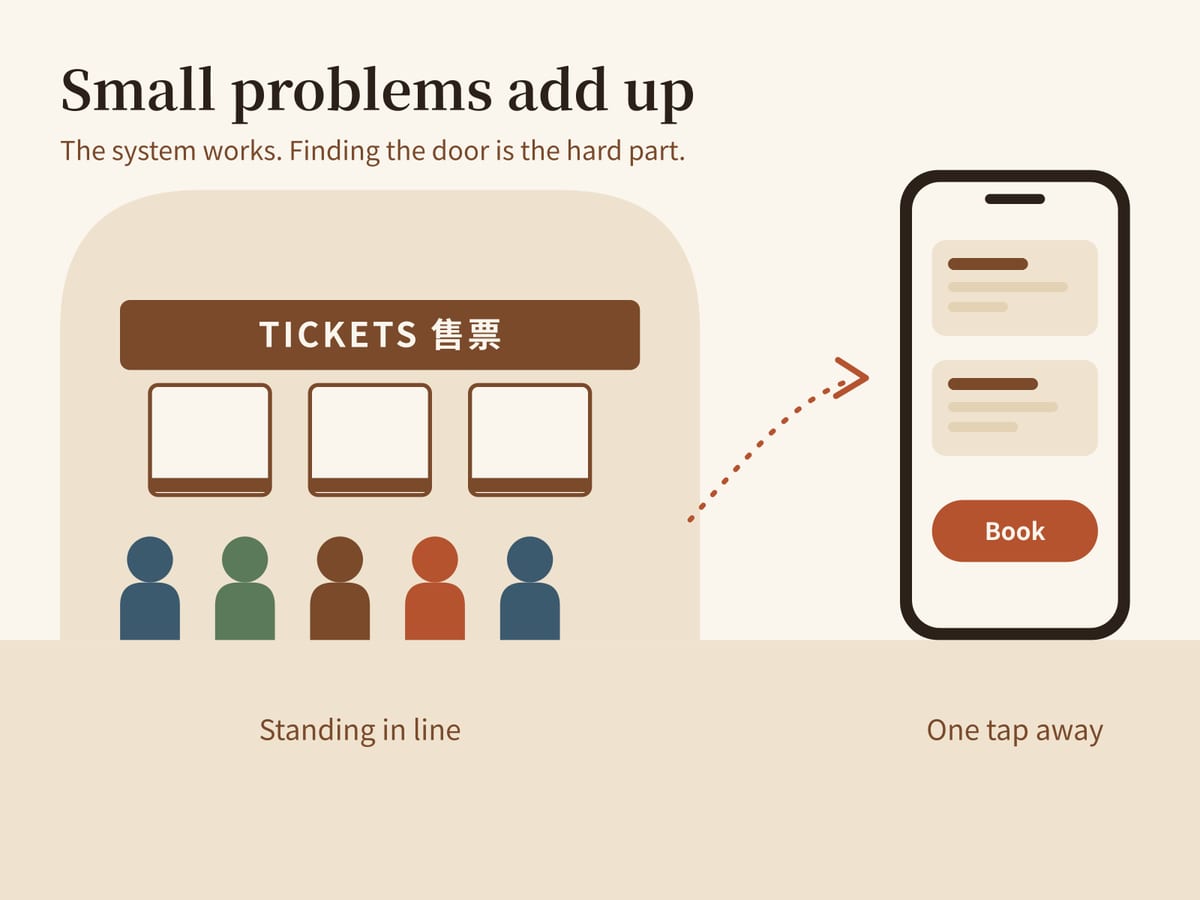
The first problem I remember wasn't dramatic. A friend who had just arrived in China didn't know how to buy a train ticket online, so they went to the station and stood in line instead.
I had moved from Guangzhou to Shanghai for graduate study in public administration, and I was meeting people from many countries. Over a few months I kept hearing small versions of the same story. Another friend had halal dietary needs and found it hard to work out, in the first weeks, where they could eat with confidence. Nobody was doing anything wrong. Each task was easy for someone who already knew how it worked, and slow and tiring for someone who didn't. When you don't yet have the language, the apps, the payment tools and the unwritten rules all at the same time, the small difficulties stack up.
I study how public systems meet the people they serve, so this was a familiar pattern: the system works, and the person standing in front of it still can't find the door.
An idea that didn't work
In spring 2026 I started wondering whether I could build something real and have actual people use it. My first attempt was a small medical information PDF that I planned to sell for about ¥30. I dropped it. Medical information goes out of date quickly, a static file is hard to keep right, and I wasn't comfortable carrying the responsibility that comes with health advice. It wasn't a product that should exist in that form, and I'm glad I found that out early and cheaply.
What I took from it was a rule I still follow: if I can't keep something accurate, I shouldn't present it as certain.
Starting smaller
In July 2026 I launched Adapt to China as a plain website of practical guides: how to get set up in the first days, how to think about renting, how to find the right hospital campus, how to look for halal or vegetarian food. I tried to give people exact Chinese names they could copy and paste into a map app, not just general advice. I also asked friends, online communities and newcomers what was actually getting in their way, and I kept adjusting.
The site is run by one person, which is also how I try to describe it. It is not an official service of my university, and it is not a large company with staff in every city.
What I learned about the last step
The biggest lesson wasn't about content. Many people who wrote to me already knew what they needed. They had found a place on an app. They knew what kind of service they wanted. What stopped them was the last step: calling a business in Mandarin, asking what the price would really be, and finding out whether a time slot existed.
A better guide cannot make that call. An AI assistant can explain a screen, translate a message or help you prepare questions, and I've spent a lot of time building that kind of help. But when a shop doesn't answer chat messages, or the quote depends on details only a conversation reveals, someone has to pick up the phone.
So the project gradually took the shape it has now, in three layers:
Free guides and directories for the questions that have standard answers.
An AI assistant to help you work out your own next step.
A person, for tasks that need Mandarin, local checking or some back-and-forth, at a small and clear cost.
Only the third layer involves anyone paying me, and I try to keep it honest about what it is. I can check a price, confirm availability and report back in English. I can't promise a booking, a price or an outcome, because those belong to the business and to you.
What this isn't
It is not a story of a finished company. It's an early project with a few real users. Some tasks went smoothly. Some taught me that I had misunderstood what a person wanted, and that asking a clarifying question first is worth more than starting fast. I'd rather show you that than pretend otherwise.
What I hope it becomes
I don't want Adapt to China to treat foreigners as people who "don't understand China." Most of the difficulty is about information, language and access, not about ability. The goal is simple: make it a little easier to feel capable and welcome in a place that isn't home yet, by explaining how things actually work and by being a reliable person to ask when something needs a local hand.
If you have a question you can't find an answer to, or something that surprised you when you arrived, I'd like to hear it. That is how most of this site has been written.
Martin Zhong
If you have a question, Ask AI.