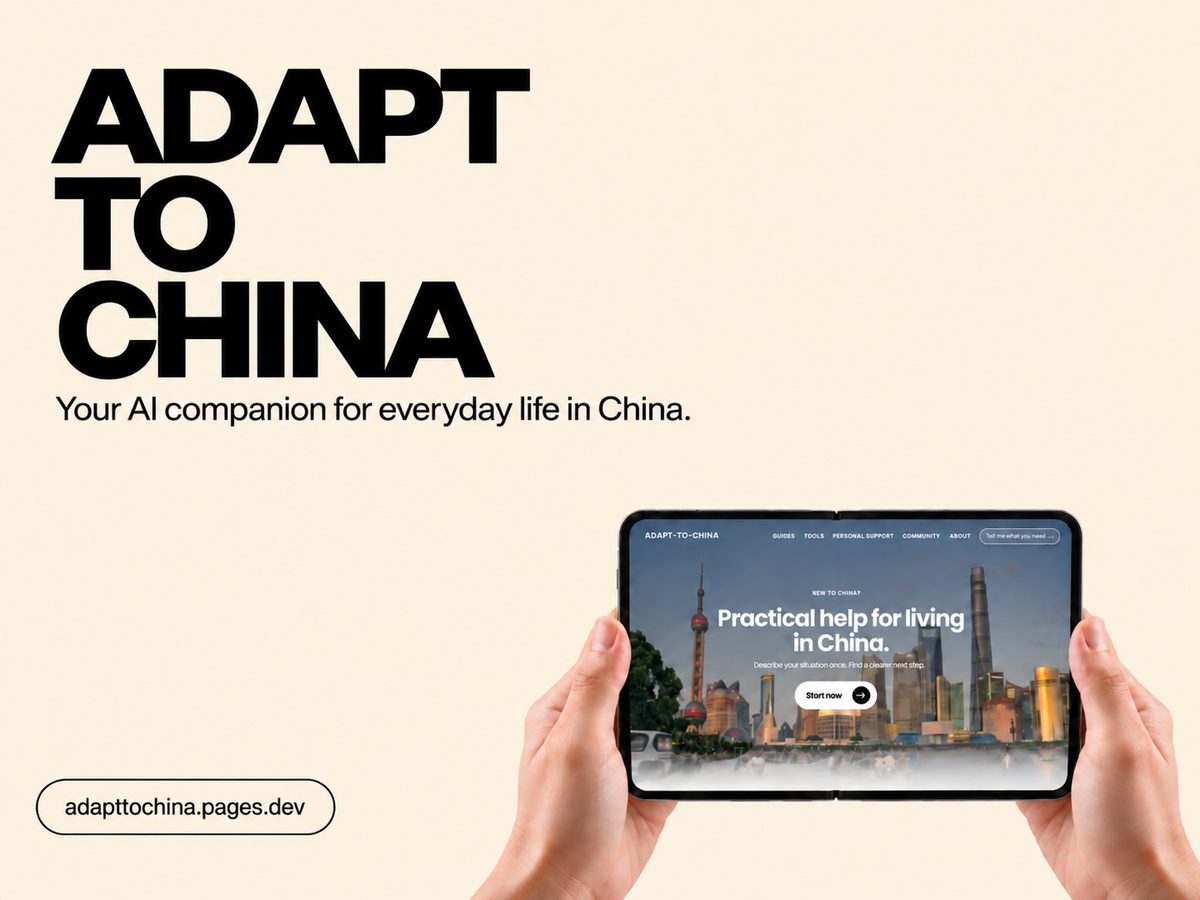
Over the past few months, I've been building my own brand, Adapt to China, an AI-assisted platform designed to help international students, professionals, and travelers navigate everyday life in China more easily.
What began as an attempt to solve a social problem has become an unexpected journey into technology and entrepreneurship, fundamentally changing how I learn, think, and make decisions.
My background is in Public Administration, where much of my research focused on understanding people's needs and how public policies could better address them. My internship at Mintel added another perspective, teaching me to break down complex market information, structure and code data, and identify patterns behind consumer trends. These experiences shaped how I approached a problem I noticed among international residents in China: many of the services they need already exist, but remain difficult to access because of language, unfamiliar platforms, and cultural differences. I began to realize that people don't just need a translator for language. Sometimes, they need a translator for services themselves.
With the help of AI, I started turning this idea into a working product, despite having little technical background. As I spoke with users from different countries, Adapt to China gradually evolved into a platform featuring an AI assistant, House Planner, Hospital Finder, Halal Food Finder, and Vegan Food Finder. Each feature reflected a deeper understanding of what users actually needed. Finding suitable food, for example, isn't always just about convenience. It can be tied to religious beliefs, cultural identity, and whether someone feels welcomed and respected in a foreign country. Meanwhile, building the platform pushed me to learn about AI models, system architecture, evaluation, and product reliability. Technology didn't just expand what I could build; it also helped turn my earlier intuitions into more informed judgments.
But making something useful and building a sustainable business are two different challenges. Unlike public policy, where addressing collective needs is often the primary objective, a commercial product must also work within the constraints of costs, revenue, and profitability. Receiving my first paid orders for personalized assistance was an important milestone, but it also raised new questions: Which problems are people willing to pay to solve? How can I reach them efficiently? How can the product deliver value consistently? These questions led me into SEO, GEO, content marketing, and business model design. Through conversations with experienced founders and my own experiments, I began to see how technology, user experience, distribution, and monetization fit together. Rather than learning these subjects independently, I was learning them because the project needed them, and gradually understanding the connections between them.
Yet what keeps me motivated goes beyond building a profitable product. I've always believed that meaningful innovation should carry a social vision. Some of the most influential technologies have done more than respond to existing needs; they've changed how people live and what they believe is possible. On a much smaller scale, I hope Adapt to China can contribute to a world where moving across borders doesn't mean losing access to essential services, familiar ways of living, or a sense of belonging.
Looking back, I don't see this journey as leaving social science behind. Instead, I'm learning to combine its understanding of human needs with the possibilities of technology and the discipline of business.
Technology gives me the means to build. Business teaches me how to make it sustainable. But my social science background gives me a reason to begin.
And perhaps that's my biggest takeaway: a product needs more than a business model. It needs a reason to matter.
Explore Adapt to China: https://adapttochina.pages.dev
#AIProducts #Entrepreneurship #ProductManagement #SocialInnovation #LearningByDoing